Continuous reliability for marine and offshore systems
Lysor reduces fouling, biofilm, and corrosion in saltwater circuits, improving heat exchange and system efficiency without shutting down equipment.
What risks does seawater pose?
On board ships, ferries, and offshore platforms, cooling systems work with seawater: salty, rich in minerals, and highly corrosive.
This leads to rapid fouling, loss of thermal efficiency, and risks of operational downtime.
Lysor intervenes where conventional treatments fail: it dissolves limescale and sediments, reduces biofilm and limits corrosion, ensuring continuity of service even in extreme conditions.
Deep decalcification in cooling systems
In open and closed circuits using salt water, limescale quickly deposits on pipes, expansion tanks, and heat exchangers.
Lysor dissolves existing scale, preventing it from reforming.
Documented results include the complete cleaning of wells and storage tanks on ferries, without shutting down the systems and without the use of corrosive acids.
Biofilm control and corrosion reduction
Biofilm under control
Marine biofilm promotes corrosion, microbial proliferation, and inefficiencies in cooling systems.
Lysor progressively removes it and prevents its return, improving the quality of the process fluid.
Reduced corrosion
The mixture binds dissolved free oxygen, one of the main factors in oxidation in naval pipelines.
This reduces corrosion, brown water, and metal damage in the long term.
Stability and safety
Lysor does not alter water chemistry, is not classified as a chemical product, and can be applied continuously without modifying flows or shutting down systems.
Continuous treatment, without shutting down the system
On board, stopping a cooling system means stopping the ship.
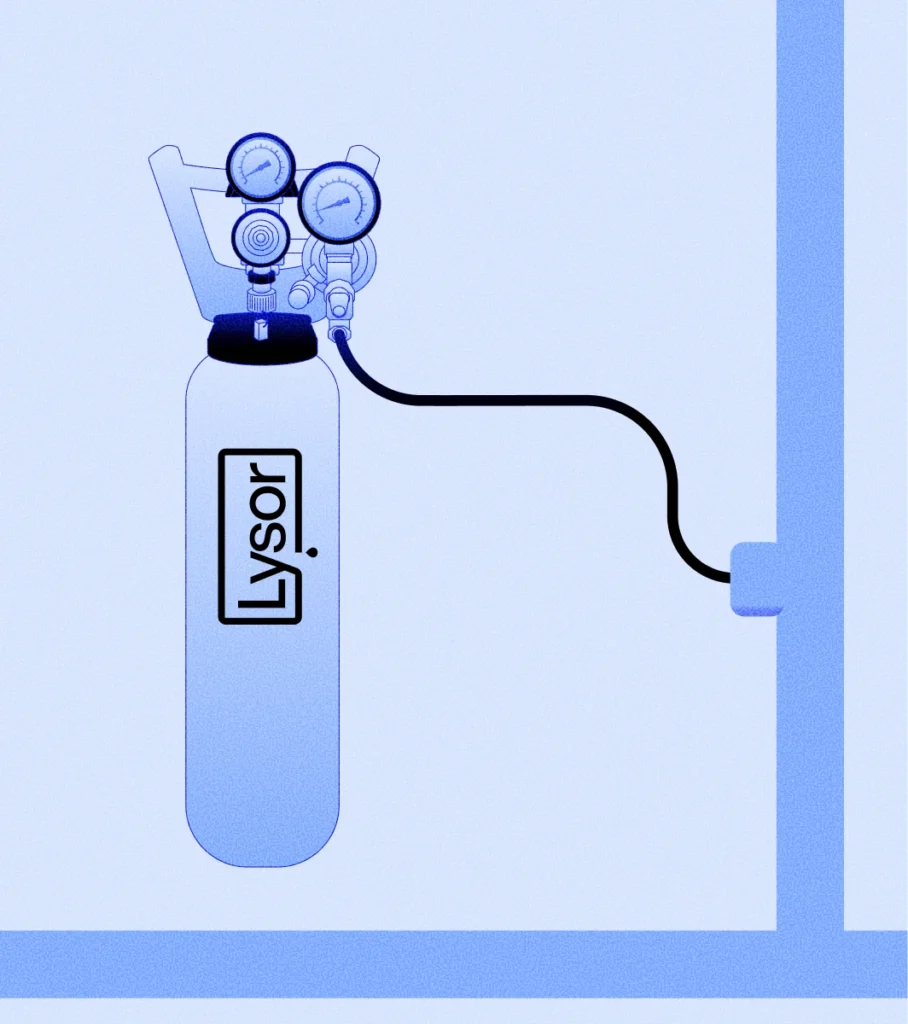
Lysor is injected directly into the circuit, without the need for emptying or interruptions: operations remain unchanged while the system cleans and stabilizes itself.
The mixture, composed of food-grade inert gases, leaves no residue, does not affect the water, and requires no maintenance.
Where Lysor is used
Contexts in which the effects of the mixture are concentrated on ships and platforms:
01
Open and closed circuit cooling systems
02
Heat exchangers and condensers
03
Saltwater-fed hydraulic circuits
04
Marine wells, storage tanks, and compensation tanks
05
Hydraulic networks subject to salt encrustation and biofilm
06
Auxiliary lines on board (pumps, pipes, technical utilities)
07
Offshore platform cooling systems
08
Pipes and systems exposed to free oxygen corrosion
09
Hydraulic systems for process fluids in marine environments
What changes with Lysor:
Reduction of fouling in marine circuits
Less corrosion and greater component durability
Improved heat exchange and lower consumption
Operational continuity without plant downtime
Elimination of marine biofilm and improved water quality
Stable performance even in high-hardness salt water
Academic validation and real results
The mixture, composed of food-grade inert gases, leaves no residue, does not affect the water, and requires no maintenance.
Proven effectiveness against limescale and biofilm
Over 58% reduction in scaling
Tests conducted on real systems have shown a significant reduction in limescale and the elimination of biofilm, resulting in a decreased bacterial load.
Reduction of microbiological parameters in healthcare settings
A study conducted on a hospital system showed a significant decrease in microbiological load and Legionella pneumophila, thanks to the blend’s action on biofilm and limescale.
Fill out the form to receive more technical details, commercial information, or request a personalized consultation.
Our team will get back to you as soon as possible.
Zero impact on water, maximum efficiency — ask us how.